

The Science Behind Building Your Dream Life
What the research says about purpose, habits, goals, and becoming who you aspire to be

There’s a version of your life that only exists in your head right now.

It’s the one that makes you wake up excited. Where the things you spend your time on actually feel like yours. Where you go to bed at night feeling like you’re moving toward something.
Most people think that life is meant for the lucky ones. The ones who were born into the right situation, or who figured themselves out early, or who just seem to have it together in ways you don’t quite understand yet.
But here’s what I want you to know: the research disagrees.
Scientists have spent decades studying how people actually build lives they love. And it turns out it’s not just about luck or perfect timing.
There’s a set of simple, learnable habits that anyone can practice to build their dream life.
Including you.
1. Figure Out What You Actually Want. Not What Everyone Else Wants for You
I used to think wanting things too much was embarrassing.
I would think to myself, “Who do you think you are to want that? Do you actually think you could have that life?”
I had somehow picked up the idea that staying quiet about your dreams was humble, and that people who set big goals were a little delusional.
It took me a while to realize that wasn’t maturity or being “realistic.” It was just fear.
Researchers Schippers and Ziegler (2019) studied what they call life crafting.
This is basically the practice of sitting down and thinking carefully about what you want your life to look like across all the big areas like your work, your relationships, your health, and how you spend your free time. What they found is that people who do this type of reflection end up happier, healthier, less depressed, and they even live longer (Schippers & Ziegler, 2019).
The catch is that the goals have to actually be yours. Research in motivational psychology shows that only goals you’ve chosen for yourself (not ones handed to you by your parents, your partner, or the life you accidentally ended up in) will actually make you feel fulfilled (Ryan & Deci, 2000, as cited in Schippers & Ziegler, 2019).
Think about everyone you know who has a good job, a nice house, all the right things, and still seems kind of miserable. That’s usually what’s going on. They built someone else’s dream, not their own.
There’s even a Japanese word for this sense of having a purpose that feels truly yours: ikigai, which roughly means feeling like your daily life is worth living (Kono et al., 2019, as cited in Schippers & Ziegler, 2019).
Studies of communities where people live unusually long lives found that having this sense of ikigai was directly connected to lower death rates even when researchers accounted for things like diet, exercise, and personality (Hill & Turiano, 2014, as cited in Schippers & Ziegler, 2019). Your sense of purpose isn’t just a nice-to-have. It might actually keep you alive longer.
You don’t need your life to be in a perfect place before you start figuring this out. Psychiatrist Viktor Frankl survived the Holocaust and came out the other side saying that life can have meaning in even the worst circumstances. What matters is deciding to look for it (Frankl, 1985, as cited in Kelly, 2023).
So start there. Ask yourself what you actually want.
It doesn’t have to be “realistic.”
It doesn’t have to “sound good” or be “prestigious.”
What do you want?
Write it down. This is only the beginning.
2. Write It Down With Details

Here’s what I’ve noticed about the people who are actually making things happen: they write stuff down. They make plans. They put things on paper until those things start to come true.
Schippers and Ziegler (2019) found that one of the most powerful things you can do is write about your best possible self.
Your best possible self should be a detailed picture of who you’d be if everything went the way you hoped. It’s not just a fantasy, but a real, thought-out vision.
Studies show that writing about the future you want makes you more optimistic, less depressed, and more likely to actually take steps toward it (Peters et al., 2010; Meevissen et al., 2011, as cited in Schippers & Ziegler, 2019).
It works because when you write something down clearly, your brain starts paying attention to it. You notice opportunities you would have missed before. You make small choices that start adding up.
The research also shows that vague goals don’t really work. What does work is what Schippers and Ziegler (2019) call goal attainment plans.
Basically, “if this happens, I will do that” plans.
Not just saying, “I want to get fit,” but saying, “Every day after work, I will go for a 20-minute walk. If I miss a day, I’ll go the next morning instead.”
That level of detail has been shown to actually lead to behavior change in a way that general intentions just don’t (Koestner et al., 2002, as cited in Schippers & Ziegler, 2019).
There’s even a neurological reason writing helps.
When you write out what you plan to do, your brain starts treating it more like something that already happened, which makes you more likely to follow through (Balcetis & Cole, 2009, as cited in Schippers & Ziegler, 2019). Writing is not just journaling. It is practice and a promise to yourself.
So, write about where you want to be in five years. Write about what your ideal week looks like. Write about how you’re going to get there, step by step, and what you’ll do when things get hard.
It sounds simple.
It’s not always easy.
But it works.
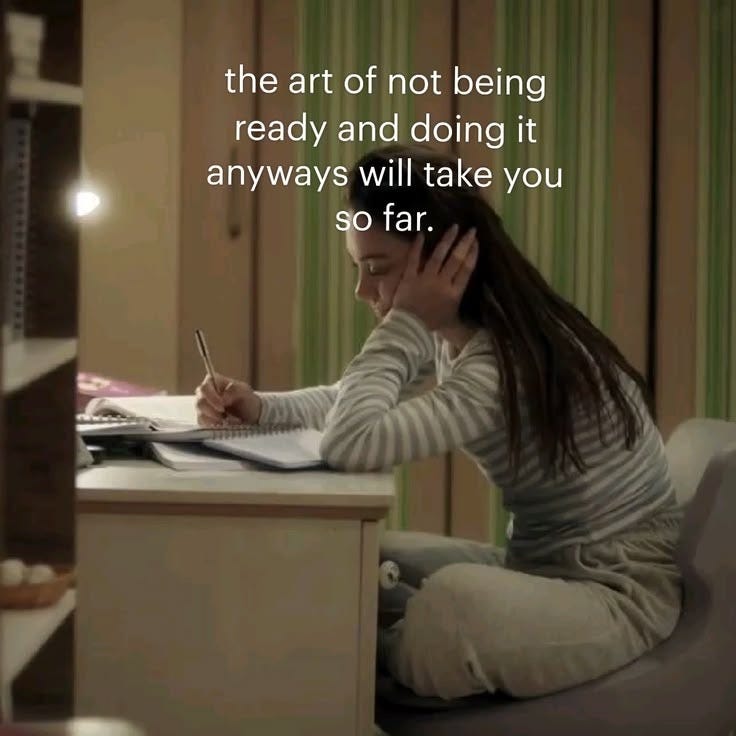
3. Don’t Wait Until You Feel Ready. Just Start Building

I told myself for a long time that I’d start once things calmed down. Once I felt more confident. Once I had more time, more money, more proof that it would actually work out.
But here’s what I’ve learned and already mentioned in previous essays: Confidence comes from doing, not from waiting.
Researchers Gardner, Lally, and Wardle (2012) studied how habits actually form.
What they found should change the way you think about motivation.
The key to sticking with something long-term isn’t having a lot of willpower or feeling excited about it every day. Those things run out. What actually works is doing the same action in the same situation over and over until your brain starts doing it automatically, like how you don’t have to think about brushing your teeth, you just do it because it’s part of your routine (Gardner et al., 2012).
You might have heard that it takes 21 days to form a habit. That number is actually a myth. It came from plastic surgery patients adjusting to how they looked after an operation (Lally et al., 2010, as cited in Gardner et al., 2012).
The real research shows it takes closer to 66 days on average. So, about ten weeks. That’s how long before a new behavior starts to feel natural and easy.
The good news is that you don’t have to be perfect. Missing a day doesn’t ruin everything! The habit can pick right back up as long as you keep returning to it (Gardner et al., 2012).
Schippers and Ziegler (2019) also point out something important.
Part of building your dream life is being honest about the gap between your current habits and the habits you’d need to get where you want to go. That gap isn’t something to feel bad about. It’s just information. It tells you what to build.
So pick one thing. Decide exactly when and where you’ll do it.
It could be after your morning coffee, on your lunch break, before you scroll on your phone at night. Do it. Keep doing it. You don’t need to feel ready. You just need to start.
4. Be Honest About What’s Actually in Your Way

This is the part most people don’t want to hear, so I’ll just say it directly.
A lot of popular advice about building your dream life is not grounded in evidence. And following that advice can actually make things worse.
Dixon, Hornsey, and Hartley (2023) did a study on what they call manifestation beliefs.
It is the idea (made famous by books like The Secret by Rhonda Byrne), that you can attract success into your life just by thinking positively, visualizing what you want, and acting like it’s already yours. They found that over a third of people believe in some version of this.
Unfortunately, the research does not completely support this belief.
People who believed strongly in manifestation thought of themselves as more successful, but when the researchers looked at actual income and education levels, those people were no different from anyone else (Dixon et al., 2023). The belief made them feel better. It didn’t actually help them get further.
Worse, the people who scored highest on manifestation beliefs were also more likely to have gone bankrupt, to have been scammed, and to have made risky financial decisions that didn’t pay off (Dixon et al., 2023). The researchers found that this type of thinking can lead people to skip the hard, practical work like planning, habit-building, and honest self-assessment because they believe their destiny is completely out of their hands and mostly relies on the universe.
This is not me dunking on manifestation, hope, or optimism. Hope is genuinely useful. But there’s a big difference between being hopeful and strategic versus being hopeful instead of strategic.
Dr. Kelly (2023), a surgeon and researcher who writes about personal growth, puts it this way: real change only happens when you stop trying to change everything around you and focus on the one thing you actually control, which is yourself. He argues that every hard situation in life is an opportunity to grow, but only if you face it honestly rather than waiting for it to disappear (Kelly, 2023).
He quotes Viktor Frankl, who says, “It doesn’t matter what we expect from life. What matters is what life is asking of us, and whether we’re willing to answer.”
So ask yourself the real question: what is actually getting in your way? What specific thing (fear, lack of a plan, the wrong goals, not enough time set aside) is keeping you stuck?
Name it.
Then address it.
5. Let People Watch You Become

The things we keep completely to ourselves tend to stay dreams forever.
As long as your future life only exists inside your own head (safe, private, never tested), it can stay “perfect.” And it will probably stay exactly there.
Schippers and Ziegler (2019) found that one of the most powerful parts of building a life you love is making a public commitment by telling someone what you’re working toward, writing it down somewhere visible, or sharing it with even just one person.
When you do that, you start to act like the person you said you were going to be. It becomes part of who you are. The research shows this makes you significantly more likely to follow through (Hollenbeck et al., 1989, as cited in Schippers & Ziegler, 2019).
Consciousness researcher Stanley Krippner (2006) studied groups of people who shared their inner lives with each other.
They shared their dreams, their fears, and their half-formed ideas about who they wanted to become. What he found was that simply being witnessed by others caused people’s real lives to change. They left jobs that weren’t right. They started things they had been putting off. They figured out what they actually wanted.
Being seen, really seen, turned out to be part of how transformation happens (Krippner, 2006).
In another essay, I wrote about how the fear of being perceived is blocking your destiny.
I understand why sharing your dreams and having them be perceived can feel scary. What if you tell someone and then you fail? What if you share something and people laugh, or don’t care, or think you’re doing too much?
But what if you succeed?
Here’s something that might help: researchers Gilovich, Medvec, and Savitsky (2000) found that we dramatically overestimate how much other people are paying attention to us. We walk around feeling like everyone is watching and judging, but the truth is, most people are too busy thinking about themselves to be watching you that closely (Gilovich et al., 2000). The audience you’re afraid of is mostly in your own head.
So tell someone what you’re building. Publish the essay. Post the video. Sign up for the class. Make it real. Dr. Kelly (2023) says it simply: write down the vision of the life you want, and take the first step toward it today.

None of this research promises that the path will be easy or straight.
Fear doesn’t go away.
Life stays complicated.
You will still have hard days.
But here’s what the science does say: the people who build lives they love are not a special category of human.
They just started.
They wrote things down. They built small habits before they felt ready. They told someone. And they kept going even when it felt uncertain.
Krippner (2006) writes that the life you’re trying to become is already inside you, waiting to take shape. It’s not some stranger you have to turn into. It’s just you, finally paying attention to the right things.
Ten years from now, you will have lived ten years either way. The only question is whether you were moving toward the life you want or waiting for the perfect moment to start.
Start now. Be specific. Build the habit. Be honest. And let someone watch you get there.
Your dream life isn’t hiding somewhere safe and quiet. It’s already out in the open, waiting for you to reach for it.
As always, please show up for yourself ♡
With endless love, Chelsea ❤︎

References
Dixon LJ, Hornsey MJ, Hartley N. “The Secret” to Success? The Psychology of Belief in Manifestation. Pers Soc Psychol Bull. 2025 Jan;51(1):49-65. doi: 10.1177/01461672231181162. Epub 2023 Jul 8. PMID: 37421301; PMCID: PMC11616226.
Gardner B, Lally P, Wardle J. Making health habitual: the psychology of ‘habit-formation’ and general practice. Br J Gen Pract. 2012 Dec;62(605):664-6. doi: 10.3399/bjgp12X659466. PMID: 23211256; PMCID: PMC3505409.
Gilovich, T., Medvec, V. H., & Savitsky, K. (2000). The spotlight effect in social judgment: An egocentric bias in estimates of the salience of one’s own actions and appearance. Journal of Personality and Social Psychology, 78(2), 211–222. https://doi.org/10.1037/0022-3514.78.2.211
Kelly JD 4th. Your Best Life: Real Change Occurs Within. Clin Orthop Relat Res. 2023 Aug 1;481(8):1483-1485. doi: 10.1097/CORR.0000000000002748. Epub 2023 Jun 22. PMID: 37345906; PMCID: PMC10344477.
Krippner, Stanley. (2018). The Construction of Reality in “Waking Life” and “Dreaming Life”. Journal of Conscious Evolution, 2(2). https://digitalcommons.ciis.edu/cejournal/vol2/iss2/15
Schippers MC, Ziegler N. Life Crafting as a Way to Find Purpose and Meaning in Life. Front Psychol. 2019 Dec 13;10:2778. doi: 10.3389/fpsyg.2019.02778. PMID: 31920827; PMCID: PMC6923189.
*Images sourced from Pinterest
Read more like this:
Don’t forget to subscribe if you would like to see more articles like this! I’ll be posting often to reach my goal of writing 100 articles by the end of the year!